Travel guide


Travel news
Is Tourism Down in the US in 2025?
8 min read·21 Oct 2025 13:18·Author: Andrew DaveyTable of contents 

Over the course of the year, policymakers, corporate insiders, and a slew of journalists have been asking: Is tourism to the United States down in 2025? In short, yes it is. We have a growing set of data, both internal and from other respected sources, showing that international tourists are increasingly opting for trips to places other than the United States.
With this said, there’s a much more complex and complicated story hidden behind the alarming headlines. There’s likely not just one specific cause for the US tourism downturn, and it’s not just foreign tourists’ decision not to book US trips that is affecting major hospitality companies’ bottom lines. So, let’s take a closer and much more detailed look to reveal how and why U.S. tourism is down in 2025.
Why Is Tourism Dropping in 2025?
Earlier this year, US travel industry insiders were spooked by a World Travel & Tourism Council report projecting that the nation is set to lose a total of US$12.5 billion in international visitor revenue in 2025. Since then, we’ve seen newer data and forecasts suggesting a somewhat less severe situation, but nonetheless one that points to a sharp turnaround from the robust growth that U.S. tourism enjoyed in 2024. Overall, Oxford Economics’ Tourism Economics division projects a national drop of $8.3 billion in visitor spending. And in specific cities like New York City, Los Angeles, Miami, and Las Vegas that have historically attracted the most international visitors, they appear to be suffering the most from the loss of foreign tourists.
What happened? It’s becoming increasingly clear that political shifts and economic pressure have both played major roles in the 2025 U.S. tourism slowdown. Since President Donald Trump returned to office, new trade disputes, tighter border and visa rules, increased immigration enforcement, and rising tensions with several countries have made the U.S. seem less welcoming and more complicated to visit for many travelers. In addition, ongoing geopolitical tensions and negative international media coverage have further shaped global sentiment toward the U.S. in a less favorable light.
At the same time, rising travel costs — from airfare and hotels to car rentals and everyday expenses — are putting additional pressure on both foreign and domestic travelers. Many tourists are rethinking long-haul trips and instead choosing more affordable destinations in Latin America, Europe, and Asia. Together, these political, economic, and behavioral factors have created a perfect storm that’s causing a noticeable decline in U.S. travel demand.
Beyond the data and analysis from outside resources, we have our own Economybookings data that we’re about to share with you below. Here’s a closer look at what we’re seeing.
Comparing 2025 vs 2024 USA travel patterns
Overall USA Demand
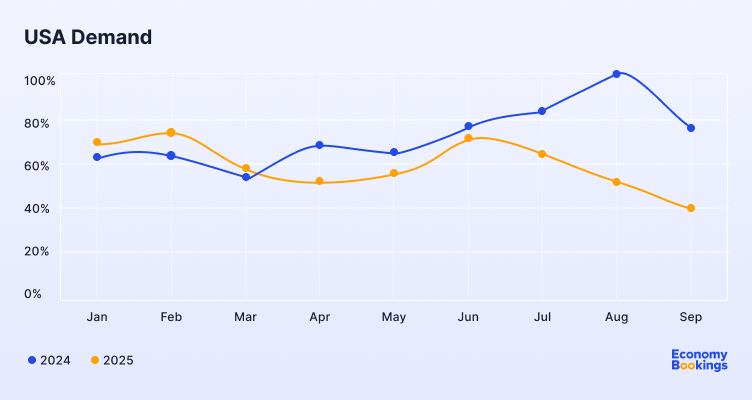
The line chart below compares car rental views for the U.S. from January to September 2025 with the same months in 2024, showing when the decline has happened. According to our numbers, interest in U.S. car rentals remained strong early in the year, but the 2025 numbers began to dip below 2024’s baseline in April.
Since April, 2025 requests for US car rentals have remained below 2024’s, even during the traditionally busy summer travel season. In fact, 2025 requests for US car rentals have actually been dropping month-to-month since June in a marked contrast to the more robust demand for US car rentals during the summer of 2024.
Which countries show the biggest decline in travel demand for the United States?
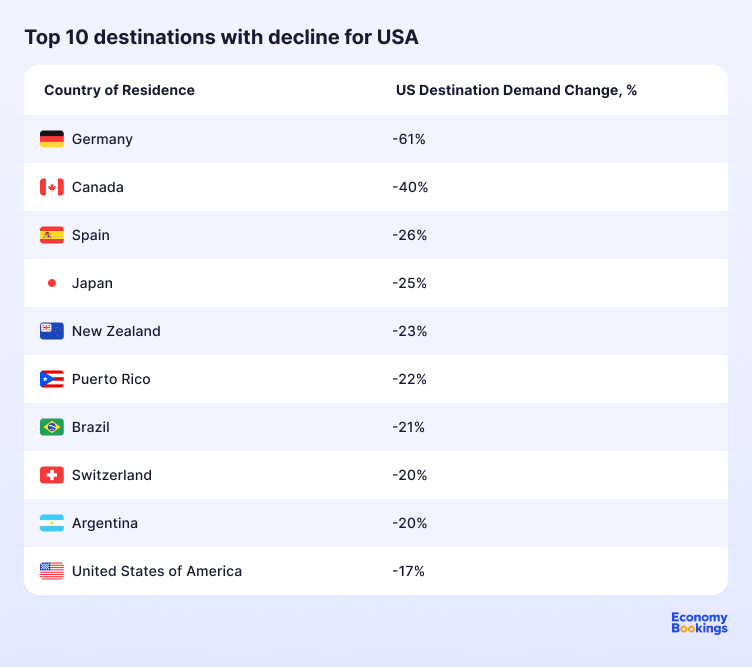
Next, let’s examine this table below showing the top 10 countries with the biggest decline in US car rental views (like the chart above, this one compares the first nine months of 2025 to the first nine months of 2024). Germany ranks number one with a steep 61% drop followed by Canada with a staggering 40% drop since last year. Considering the ongoing trade tensions, “51st state” rhetoric, growing travel costs, and the weaker Canadian dollar, our data seem to confirm outside reports of a sustained drop in Canadians opting for US travel.
However, we also notice a few surprises. Though Spain and Switzerland also make the top 10, no other European nation does besides Germany. More notably, the United States itself appears on the list, signaling that domestic demand has also weakened. Not only are Puerto Rican bookings down for US mainland cars, but so are bookings within the US mainland.
Why Has US Tourism Declined Domestically?
While the losses in international travel are noticeable in major markets, a drop in domestic travel will be felt more across the country. In addition to our own data, U.S. news outlets like NPR and CNBC have reported on other data showing a weakening domestic tourism market.
What’s happening in the United States? Recent trade and tariff policies, often discussed in the context of foreign relations, have also had an inflationary impact at home, adding new pressure to the nation’s already high cost of living. Speaking of rising costs, higher prices for essentials like housing, groceries, and utilities mean less discretionary income for leisure travel. And with costs also rising for travel-related items like lodging, entertainment, and restaurant meals, that makes it even harder for working-class US consumers to book the trips they want.
Perhaps, no market better exemplifies the complexities of US travel in 2025 than Las Vegas. While casino companies like Wynn that primarily cater to luxury travelers have had an easier time weathering the storms of 2025, companies like MGM Resorts and Caesars Entertainment that have more diverse portfolios of casino resorts are having a rougher time, especially as consumer complaints about rising prices go viral on social media. Though the loss of international tourists has sparked a lot of speculation, the drop in domestic tourists points to a bigger problem for resorts seeking to keep hotel rooms and casino floors filled.
Basically, we should not expect an “easy” process to “replace” lost international travellers with domestic tourists. Domestic tourists are likely more price-sensitive than international travellers who are typically more willing to spend up for the “trip of a lifetime.” And since Americans had already begun complaining about rising travel costs before 2025, the US travel market will probably experience more turbulence before reaching a new equilibrium.
What are the current travel trends?
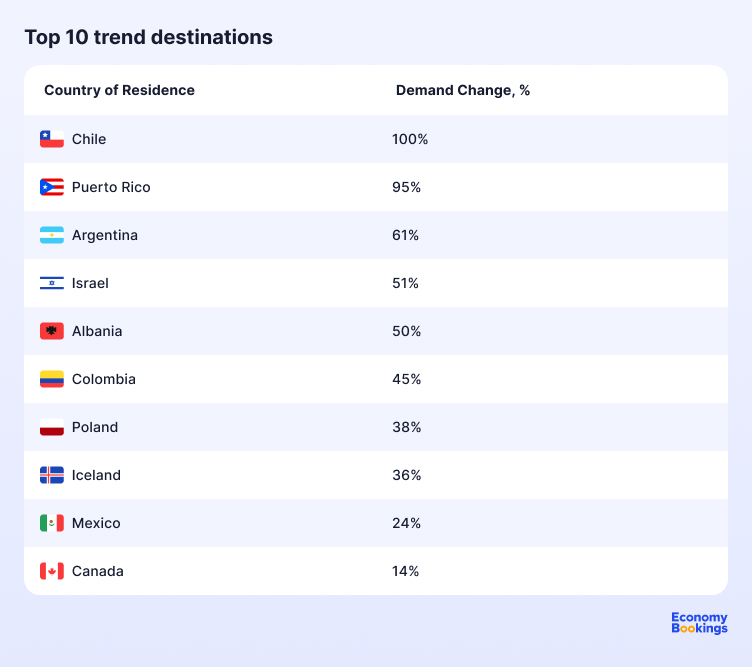
Next, let’s view this table showing changes by country in rental car demand. Like our other charts, this measures up the January to September period of 2025 to the first nine months of 2024. But this time, we’re looking at where else people want to book.
Overall, 2025 travel trends show a clear shift toward Latin American and smaller European destinations, as travelers seek more affordable and accessible alternatives to the U.S.. Interestingly, Chile leads the pack, and fellow South American nations Argentina and Colombia join Chile on this list. And though U.S. neighbours Mexico and Canada show growth in rental car demand, so are European nations like Poland and Iceland, along with Israel in the Middle East.
What’s Next for US Tourism?
Will US travel businesses need to wait until 2029 to see a recovery in international visitors? Maybe not, as the US is set to co-host the FIFA World Cup next year, followed by the 2028 Summer Olympics, both of which could provide a much-needed boost for inbound travel. However, recent political tensions, economic uncertainty, and rising costs may continue to weigh on the nation’s image abroad, potentially slowing the pace of recovery.
In short, ongoing domestic and geopolitical challenges have made the U.S. appear less predictable to some international travelers, while economic pressures at home are limiting how much Americans can spend on leisure trips. If international arrivals remain weak, it could further strain domestic tourism and the wider U.S. economy.
In the future, the US will have opportunities to roll out a warmer welcome to the world, particularly during the 2026 World Cup and the 2028 Olympics. It remains to be seen whether the country will seize these opportunities to reset the narrative. After all, this country that’s home to high-profile cities like New York and Los Angeles, and to natural landmarks like the Blue Ridge Mountains and the Grand Canyon, shouldn’t have so much trouble attracting visitors.
At EconomyBookings, we remain hopeful that U.S. tourism will gradually return to normalcy as economic conditions stabilize and international sentiment improves. With the right mix of policy support, positive perception, and global events ahead, the United States still has every chance to reaffirm its position as one of the world’s most visited and admired destinations.





Find and compare cheap car rental deals






Get the AppBook faster with EconomyBookings
- All trips in one place
- Instant confirmation
- App-only deals